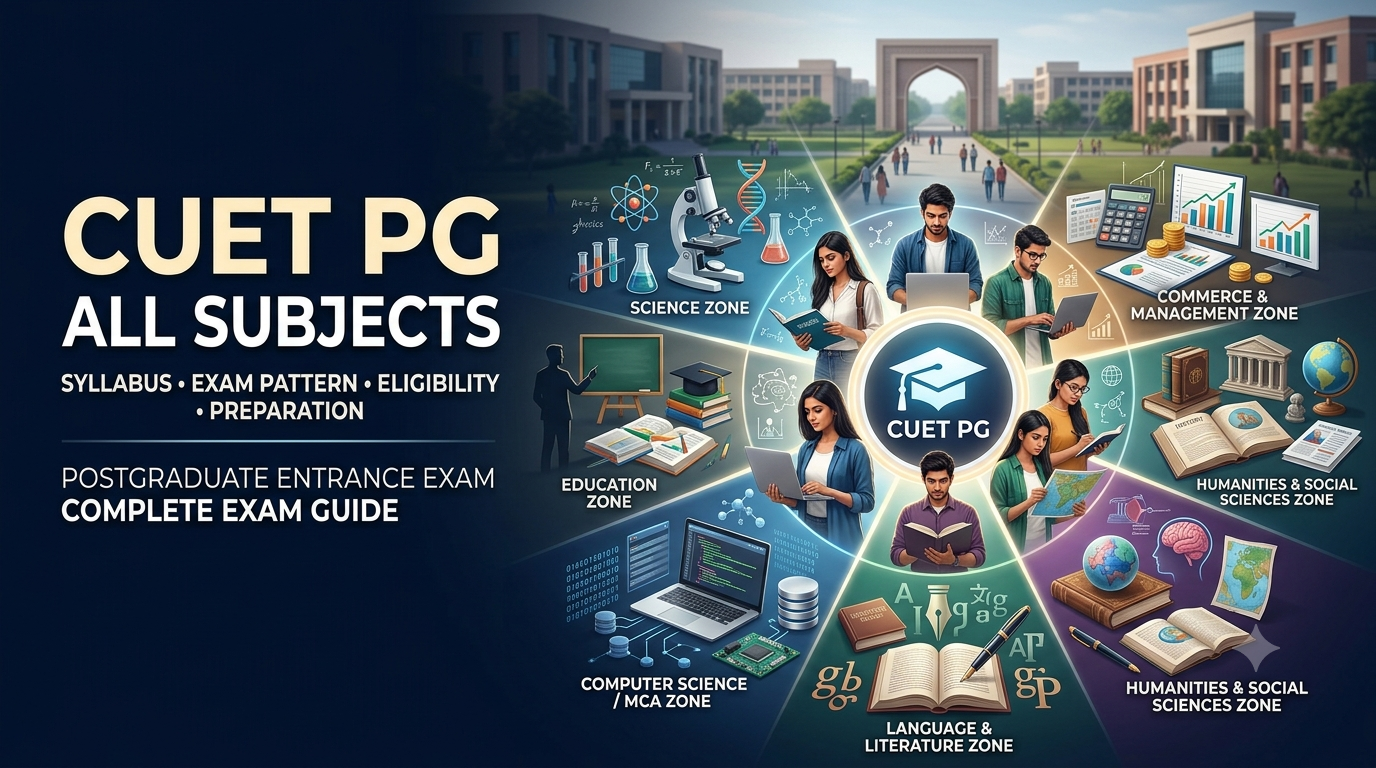
CUET PG: Syllabus, Exam Pattern, Eligibility, All Subjects, Preparation Strategy & FAQs
Planning to pursue a Postgraduate degree from a Central University or another participating university? The Common University Entrance Test (CUET PG) provides a common entrance platform for postgraduate admissions across participating universities and institutions.
CUET PG covers a wide range of postgraduate programmes and subject areas. Candidates can choose the relevant test paper(s) according to the programme and university requirements.
From M.A., M.Sc. and M.Com. to MCA, MBA, M.Ed. and other postgraduate programmes, CUET PG offers candidates an opportunity to apply through a common entrance process.
This complete guide covers CUET PG syllabus, exam pattern, subject-wise preparation, eligibility, participating universities, admission process, preparation strategy, important tips and frequently asked questions.
Important: CUET PG programme eligibility, participating universities, test paper requirements, syllabus and admission rules can vary by programme and university. Candidates should always check the latest official CUET PG information bulletin and the programme-specific eligibility criteria before applying.
CUET PG: Quick Overview
| Particular | Details |
|---|---|
| Exam Name | Common University Entrance Test – Postgraduate (CUET PG) |
| Level | Postgraduate Entrance Examination |
| Conducting Body | National Testing Agency (NTA) |
| Mode | Computer-Based Test |
| Purpose | Admission to Postgraduate Programmes |
| Subjects | Multiple Test Papers / Subject Areas |
| Question Type | Objective-Type Questions |
| Admission | Participating Universities and Institutions |
| Eligibility | Depends on the Programme & University |
| Exam Language | Depends on the Test Paper |
What is CUET PG?
CUET PG is a national-level entrance examination conducted by the National Testing Agency (NTA) for admission to postgraduate programmes offered by participating universities and institutions.
Instead of appearing separately for different university entrance examinations, candidates can use the CUET PG platform to apply for eligible programmes at participating institutions.
However, qualifying CUET PG does not automatically guarantee admission. Candidates must fulfil the eligibility requirements and participate in the admission process of the concerned university.
CUET PG Exam Pattern
CUET PG is conducted in Computer-Based Test (CBT) mode.
The exact examination structure, number of questions, duration, marking scheme and test-paper requirements should be checked in the latest official information bulletin because the pattern can be revised.
Candidates should verify:
-
Number of Questions
-
Total Marks
-
Exam Duration
-
Marking Scheme
-
Negative Marking
-
Test Paper Code
-
Medium of Examination
-
Subject-Specific Requirements
The examination is generally objective in nature and requires candidates to combine conceptual knowledge with speed and accuracy.
CUET PG Subject-Wise Structure
CUET PG provides test papers across a wide range of disciplines.
The available subjects can broadly be grouped into the following categories:
Science & Technology
-
Physics
-
Chemistry
-
Mathematics
-
Statistics
-
Computer Science
-
Computer Applications
-
Life Sciences
-
Biotechnology
-
Environmental Science
-
Geology
-
Earth Sciences
Commerce & Management
-
Commerce
-
Accountancy
-
Economics
-
Business Management
-
Management Studies
-
Finance-related subjects
Humanities & Social Sciences
-
History
-
Political Science
-
Sociology
-
Psychology
-
Geography
-
Philosophy
-
Anthropology
-
Public Administration
-
Social Work
-
Education
Languages & Literature
-
English
-
Hindi
-
Sanskrit
-
Urdu
-
Punjabi
-
Bengali
-
Tamil
-
Telugu
-
Malayalam
-
Marathi
-
Other language-based subjects
Professional & Other Disciplines
Depending on the participating universities and available programmes, CUET PG may include test papers related to:
-
MCA
-
M.Ed.
-
LLM
-
Journalism & Mass Communication
-
Library & Information Science
-
Physical Education
-
Tourism
-
Archaeology
-
Performing Arts
-
Other specialised disciplines
The availability of a subject or programme can change. Always check the latest official subject list and university programme mapping.
CUET PG Syllabus
The CUET PG syllabus is subject-specific.
Candidates should not prepare from one common syllabus for all subjects. The appropriate syllabus depends on the test paper selected and the postgraduate programme being targeted.
Below is a broad preparation framework for major subject categories.
CUET PG Physics Syllabus
Important areas generally include:
-
Classical Mechanics
-
Mathematical Physics
-
Electromagnetism
-
Quantum Mechanics
-
Thermodynamics
-
Statistical Physics
-
Optics
-
Electronics
-
Solid State Physics
-
Nuclear Physics
-
Atomic Physics
-
Molecular Physics
Candidates should focus on concepts, formulas, numerical problems and previous questions.
CUET PG Chemistry Syllabus
Important areas include:
Physical Chemistry
-
Thermodynamics
-
Chemical Kinetics
-
Quantum Chemistry
-
Electrochemistry
-
Surface Chemistry
-
Solutions
-
Chemical Equilibrium
Organic Chemistry
-
General Organic Chemistry
-
Hydrocarbons
-
Stereochemistry
-
Reaction Mechanisms
-
Carbonyl Compounds
-
Aromatic Compounds
-
Biomolecules
-
Named Reactions
Inorganic Chemistry
-
Periodic Properties
-
Chemical Bonding
-
Coordination Chemistry
-
Organometallic Chemistry
-
s-Block and p-Block Elements
-
d-Block Elements
-
Bioinorganic Chemistry
CUET PG Mathematics Syllabus
Important topics include:
-
Algebra
-
Linear Algebra
-
Calculus
-
Real Analysis
-
Complex Analysis
-
Differential Equations
-
Coordinate Geometry
-
Abstract Algebra
-
Probability
-
Statistics
-
Numerical Methods
-
Vector Calculus
-
Mathematical Methods
Focus on both conceptual understanding and problem-solving speed.
CUET PG Computer Science / MCA Syllabus
Candidates preparing for Computer Science or MCA-related programmes should focus on topics such as:
-
Computer Fundamentals
-
Programming
-
Data Structures
-
Algorithms
-
Database Management Systems
-
Operating Systems
-
Computer Networks
-
Computer Organisation
-
Software Engineering
-
Web Technologies
-
Discrete Mathematics
-
Theory of Computation
-
Digital Logic
-
Object-Oriented Programming
The exact syllabus depends on the selected test paper and programme.
CUET PG Commerce Syllabus
Important areas include:
Accountancy
-
Financial Accounting
-
Corporate Accounting
-
Cost Accounting
-
Management Accounting
-
Auditing
Business Studies / Management
-
Business Organisation
-
Management Principles
-
Marketing
-
Human Resource Management
-
Financial Management
-
Business Environment
Economics
-
Microeconomics
-
Macroeconomics
-
Indian Economy
-
Statistics
-
Money and Banking
-
Public Finance
-
International Economics
CUET PG Economics Syllabus
Important topics include:
-
Microeconomics
-
Macroeconomics
-
Mathematical Economics
-
Statistics
-
Econometrics
-
Indian Economy
-
Public Economics
-
International Economics
-
Development Economics
-
Money and Banking
Candidates should practise both theoretical and numerical questions.
CUET PG History Syllabus
Important areas include:
-
Ancient Indian History
-
Medieval Indian History
-
Modern Indian History
-
Indian National Movement
-
Colonialism
-
Post-Independence India
-
World History
-
Historiography
-
Culture and Heritage
-
Social and Economic History
Prepare through timelines, important events, personalities and analytical understanding.
CUET PG Political Science Syllabus
Important topics include:
-
Political Theory
-
Indian Political System
-
Indian Constitution
-
Comparative Politics
-
International Relations
-
Political Institutions
-
Public Policy
-
Political Thought
-
Governance
-
International Organisations
Regular revision of concepts and thinkers is important.
CUET PG Sociology Syllabus
Important topics include:
-
Sociological Thinkers
-
Social Institutions
-
Social Stratification
-
Social Change
-
Indian Society
-
Rural and Urban Sociology
-
Gender
-
Caste
-
Tribe
-
Family and Kinship
-
Social Movements
-
Research Methodology
CUET PG Psychology Syllabus
Important areas include:
-
Introduction to Psychology
-
Research Methods
-
Biological Basis of Behaviour
-
Learning
-
Memory
-
Intelligence
-
Personality
-
Motivation
-
Emotion
-
Social Psychology
-
Developmental Psychology
-
Psychological Disorders
-
Statistics
CUET PG Geography Syllabus
Important topics include:
-
Physical Geography
-
Human Geography
-
Economic Geography
-
Population Geography
-
Regional Geography
-
Environmental Geography
-
Geomorphology
-
Climatology
-
Oceanography
-
Cartography
-
Remote Sensing
-
Geographic Information Systems
CUET PG English Syllabus
Important areas include:
-
British Literature
-
Indian Writing in English
-
American Literature
-
World Literature
-
Literary Theory
-
Literary Criticism
-
Poetry
-
Drama
-
Fiction
-
Prose
-
Grammar
-
Vocabulary
-
Reading Comprehension
Candidates should combine literature study with regular practice questions.
CUET PG Hindi Syllabus
Important areas include:
-
Hindi Literature
-
Hindi Poetry
-
Hindi Prose
-
Hindi Drama
-
Hindi Fiction
-
Hindi Grammar
-
Literary Criticism
-
Literary Movements
-
Major Writers and Works
-
History of Hindi Literature
-
Language and Linguistics
CUET PG Education Syllabus
For Education-related programmes, important areas can include:
-
Educational Psychology
-
Philosophical Foundations
-
Sociological Foundations
-
Educational Thinkers
-
Curriculum
-
Assessment
-
Guidance and Counselling
-
Inclusive Education
-
Teaching-Learning Process
-
Educational Technology
-
Research Methodology
-
Educational Management
CUET PG Eligibility
CUET PG eligibility is programme-specific.
Candidates must satisfy the educational qualification and other conditions prescribed by the university for the programme they want to join.
Eligibility may depend on:
-
Bachelor's Degree
-
Subject/Discipline Studied
-
Minimum Marks
-
Required Subjects
-
Category Requirements
-
University-Specific Conditions
-
Other Programme-Specific Rules
Some programmes may require candidates to have studied a particular subject during graduation.
Therefore, candidates should always check the specific university and programme eligibility criteria before selecting a test paper.
CUET PG Admission Process
The admission process generally follows these stages:
Step 1: Registration
Candidates complete the CUET PG application form through the prescribed process.
Step 2: Select Test Paper
Candidates select the relevant test paper according to their target programme and eligibility.
Step 3: Appear for the Examination
Candidates take the computer-based entrance examination.
Step 4: Result
The examination authority releases the applicable result/score information.
Step 5: University Registration
Candidates may need to separately register for counselling or admission at the universities they wish to join.
Step 6: Choice Filling / Counselling
Candidates select eligible programmes according to the concerned university's admission procedure.
Step 7: Seat Allotment / Admission
Admission is completed according to the university's merit, eligibility, seat availability, reservation rules and other applicable criteria.
How to Choose the Right CUET PG Subject?
Choosing the correct test paper is an important step.
Before selecting a subject, check:
1. Your Graduation Subject
Identify the subjects you studied during your bachelor's degree.
2. Target Programme
Decide which postgraduate course you want to pursue.
3. University Eligibility
Check whether the university accepts the selected CUET PG test paper for your desired programme.
4. Test Paper Mapping
Verify the exact test paper code and programme mapping in the latest admission information.
5. Career Goal
Choose a postgraduate programme aligned with your academic interests and long-term career plans.
CUET PG Preparation Strategy
A simple preparation formula is:
SYLLABUS → CONCEPTS → NOTES → PYQs → MOCK TEST → ANALYSIS → REVISION
Step 1: Identify Your Exact Test Paper
CUET PG is subject-specific.
First decide:
Course → University → Eligibility → Test Paper
Step 2: Download the Latest Syllabus
Create a topic-wise checklist and mark:
-
Strong Topics
-
Average Topics
-
Weak Topics
Step 3: Build Conceptual Clarity
Study your graduation-level subject systematically.
Step 4: Make Short Notes
Prepare concise notes for:
-
Definitions
-
Formulas
-
Important Theories
-
Thinkers
-
Dates
-
Concepts
-
Important Facts
Step 5: Practise Previous Questions
Solve questions topic-wise before moving to full-length tests.
Step 6: Take Mock Tests
Mock tests help improve:
-
Speed
-
Accuracy
-
Time Management
-
Question Selection
Step 7: Analyse Your Performance
After each test, review:
Wrong Questions + Unattempted Questions + Guesswork + Time-Consuming Questions
Step 8: Revise Regularly
Use spaced revision rather than studying everything only before the examination.
CUET PG 90-Day Preparation Plan
| Phase | Focus |
|---|---|
| Days 1–30 | Complete Core Concepts |
| Days 31–50 | Advanced Topics + Topic-Wise Practice |
| Days 51–65 | PYQs + Revision |
| Days 66–80 | Sectional / Full-Length Tests |
| Days 81–90 | Final Revision + Mock Tests |
Daily Study Routine
| Activity | Focus |
|---|---|
| Concept Study | Core Subject |
| Practice | MCQs |
| PYQs | Topic-Wise Questions |
| Revision | Short Notes |
| Mock Test | Regular Practice |
| Analysis | Mistake Identification |
Adjust the timetable according to your selected subject and preparation level.
CUET PG Preparation Tips
1. Follow the Official Syllabus
Do not study random topics without checking whether they are relevant to your selected test paper.
2. Focus on Your Graduation-Level Subject
Many CUET PG test papers require strong subject knowledge.
3. Make Revision Notes
Short notes can make final revision much faster.
4. Practise MCQs
Conceptual knowledge should be converted into exam-oriented practice.
5. Solve PYQs
Previous questions help you understand question style and difficulty.
6. Take Regular Mock Tests
Do not wait until the final weeks to start mock tests.
7. Track Your Mistakes
Maintain a mistake notebook and revise it regularly.
Common Mistakes in CUET PG Preparation
Mistake 1: Choosing a Test Paper Without Checking Eligibility
Always verify the programme-specific requirements first.
Mistake 2: Studying Without the Syllabus
Use the official syllabus as your preparation roadmap.
Mistake 3: Ignoring Graduation-Level Concepts
For subject-specific papers, strong fundamentals are essential.
Mistake 4: Skipping PYQs
PYQs are an important part of exam-oriented preparation.
Mistake 5: Taking Mocks Without Analysis
A mock test becomes much more useful when you analyse your errors afterward.
Mistake 6: Leaving Revision for the End
Revision should be part of your weekly study plan.
CUET PG Preparation with TDC Classes
CUET PG preparation requires a subject-specific and exam-oriented strategy.
At TDC Classes, students can follow structured preparation support with:
-
Concept-Based Classes
-
Experienced Faculty
-
Subject-Wise Preparation
-
Mathematics & Science
-
Computer Science / MCA
-
Commerce
-
Economics
-
Humanities
-
Languages
-
Education
-
PYQ-Based Practice
-
Test Series
-
Study Material
-
Mock Tests
-
Doubt Support
-
Revision Strategy
TDC Classes focuses on helping postgraduate entrance aspirants strengthen their subject fundamentals and prepare systematically for competitive examinations.
CUET PG Frequently Asked Questions
Q1. What is CUET PG?
CUET PG is a postgraduate entrance examination conducted by NTA for admission to postgraduate programmes at participating universities and institutions.
Q2. Who conducts CUET PG?
CUET PG is conducted by the National Testing Agency (NTA).
Q3. What subjects are available in CUET PG?
CUET PG offers test papers across numerous disciplines including Science, Commerce, Humanities, Languages, Computer Applications, Education and other specialised areas.
Q4. Can I apply for multiple CUET PG subjects?
The number and combination of test papers that a candidate can select are governed by the applicable year's rules. Candidates should check the latest official information bulletin.
Q5. Is CUET PG syllabus the same for all subjects?
No. The syllabus is subject-specific and depends on the selected test paper.
Q6. Can final-year graduation students apply?
Eligibility for appearing and admission depends on the applicable rules and programme requirements. Candidates should check the latest official notification.
Q7. Does CUET PG guarantee admission to a university?
No. Admission depends on the concerned university's eligibility requirements, admission process, merit, seat availability and other applicable criteria.
Q8. How should I prepare for CUET PG?
First identify your target programme and test paper, then study the official syllabus, strengthen subject concepts, practise MCQs, solve PYQs, take mock tests and revise regularly.
Q9. Is CUET PG useful for MCA aspirants?
CUET PG includes test papers relevant to certain postgraduate computer-related programmes, subject to the programme and university requirements.
Q10. Where can I check the latest CUET PG information?
Candidates should refer to the latest official CUET PG information bulletin and the admission pages of the universities and programmes they are targeting.
Final Words
CUET PG provides a common entrance platform for postgraduate admissions across participating universities and institutions.
Because the examination covers multiple disciplines, preparation should always be based on the candidate's specific programme, university and test paper.
A strong preparation cycle is:
Check Eligibility → Select Test Paper → Follow Syllabus → Build Concepts → Practise MCQs → Solve PYQs → Take Mocks → Analyse → Revise
Whether you are preparing for M.Sc., M.A., M.Com., MCA, M.Ed. or another postgraduate programme, a clear strategy and consistent practice can help you stay organised throughout your preparation.
TDC Classes — Learn. Practice. Revise. Achieve.