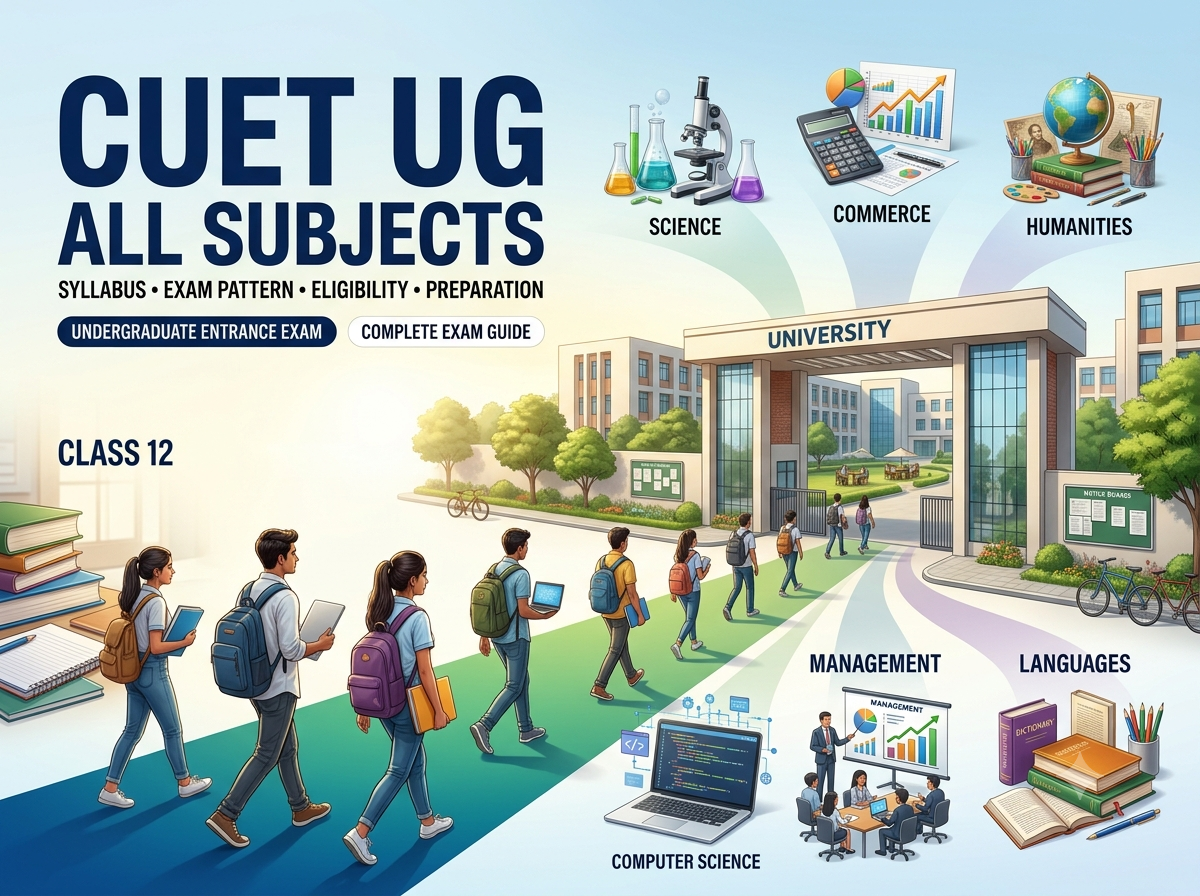
CUET UG: Syllabus, Exam Pattern, Eligibility, All Subjects, Preparation Strategy & FAQs
Planning to pursue undergraduate admission at a Central University or another participating university after Class 12? The Common University Entrance Test (CUET UG) provides a common entrance platform for undergraduate admissions across participating universities and institutions.
CUET UG offers students the opportunity to apply for a wide range of undergraduate programmes through subject-based entrance tests. Depending on the university and programme, candidates may need to appear for a combination of Language, Domain-Specific Subjects and General Aptitude Test.
From B.A., B.Sc. and B.Com. to BBA, BCA and other undergraduate programmes, CUET UG covers a wide range of academic options.
This complete guide covers CUET UG syllabus, exam pattern, subject-wise preparation, eligibility, subject selection, admission process, preparation strategy, important tips and frequently asked questions.
Important: CUET UG subject requirements, programme eligibility, participating universities, test structure and admission rules can vary by university and programme. Candidates should always check the latest official information bulletin and the specific university's admission requirements before applying.
CUET UG: Quick Overview
| Particular | Details |
|---|---|
| Exam Name | Common University Entrance Test – Undergraduate (CUET UG) |
| Level | Undergraduate Entrance Examination |
| Conducting Body | National Testing Agency (NTA) |
| Mode | Computer-Based Test |
| Purpose | Admission to Undergraduate Programmes |
| Subjects | Languages, Domain Subjects & General Aptitude Test, as applicable |
| Question Type | Objective-Type Questions |
| Admission | Participating Universities and Institutions |
| Eligibility | Depends on Programme & University |
| Medium | Depends on the Selected Test |
What is CUET UG?
CUET UG stands for Common University Entrance Test – Undergraduate.
It is a national-level entrance examination conducted by the National Testing Agency (NTA) for undergraduate admissions at participating universities and institutions.
The examination allows students to use CUET UG scores as part of the admission process for eligible programmes offered by participating institutions.
However, simply appearing for or qualifying in CUET UG does not automatically guarantee admission. Candidates must fulfil the eligibility requirements and complete the admission process prescribed by the concerned university.
Why is CUET UG Important?
CUET UG provides students with a common entrance platform for undergraduate admissions across participating institutions.
It can be useful for students who want to explore programmes in areas such as:
-
Science
-
Commerce
-
Humanities
-
Languages
-
Management
-
Computer Applications
-
Social Sciences
-
Education
-
Other undergraduate disciplines
The biggest advantage of a structured common entrance process is that students can prepare around clearly defined test subjects while simultaneously exploring eligible programmes across participating universities.
CUET UG Exam Pattern
CUET UG is conducted in Computer-Based Test (CBT) mode.
The examination structure can include:
1. Language Tests
Candidates may choose from the languages available under the applicable examination framework.
2. Domain-Specific Subjects
These are subjects selected according to the candidate's target programme and university requirements.
Examples include:
-
Mathematics
-
Physics
-
Chemistry
-
Biology
-
Accountancy
-
Business Studies
-
Economics
-
History
-
Political Science
-
Geography
-
Psychology
-
Sociology
-
Computer Science
-
Physical Education
-
Other available subjects
3. General Aptitude Test
Where required, preparation can include:
-
General Knowledge
-
Current Affairs
-
General Mental Ability
-
Numerical Ability
-
Quantitative Reasoning
-
Logical & Analytical Reasoning
Note: The number of subjects a candidate can select, examination duration, question distribution, marking scheme and subject combination should be verified from the latest official CUET UG information bulletin.
CUET UG Syllabus
CUET UG preparation is divided into different components depending on the subjects selected by the candidate.
The broad structure is:
LANGUAGE + DOMAIN SUBJECTS + GENERAL APTITUDE TEST
Candidates should select subjects based on their desired programme and the eligibility requirements of the universities they are targeting.
CUET UG Language Syllabus
Language preparation generally focuses on:
-
Reading Comprehension
-
Vocabulary
-
Grammar
-
Synonyms
-
Antonyms
-
Sentence Correction
-
Rearrangement
-
Verbal Ability
-
Literary Understanding
-
Interpretation of Passages
Reading Comprehension
Candidates should practise different types of passages and learn to identify:
-
Main Idea
-
Supporting Details
-
Inference
-
Tone
-
Context
-
Conclusion
Regular reading can improve comprehension speed and vocabulary.
CUET UG Mathematics Syllabus
Mathematics preparation should follow the prescribed syllabus for the selected examination.
Important areas may include:
-
Relations and Functions
-
Algebra
-
Matrices
-
Determinants
-
Calculus
-
Probability
-
Statistics
-
Vectors
-
Three-Dimensional Geometry
-
Coordinate Geometry
-
Linear Programming
-
Mathematical Reasoning
-
Numerical Applications
Candidates should focus on conceptual clarity, formulas and regular MCQ practice.
CUET UG Physics Syllabus
Important areas include:
-
Electrostatics
-
Current Electricity
-
Magnetic Effects of Current
-
Electromagnetic Induction
-
Alternating Current
-
Electromagnetic Waves
-
Optics
-
Dual Nature of Matter
-
Atoms and Nuclei
-
Semiconductor Electronics
-
Other prescribed Class 12 topics
Students should prepare concepts, formulas, numerical problems and objective questions.
CUET UG Chemistry Syllabus
Chemistry preparation can be divided into:
Physical Chemistry
-
Solutions
-
Electrochemistry
-
Chemical Kinetics
-
Surface Chemistry
-
Thermodynamics
-
Equilibrium
Organic Chemistry
-
Haloalkanes and Haloarenes
-
Alcohols, Phenols and Ethers
-
Aldehydes, Ketones and Carboxylic Acids
-
Amines
-
Biomolecules
-
Polymers
-
Organic Reaction Mechanisms
Inorganic Chemistry
-
Coordination Compounds
-
d- and f-Block Elements
-
Periodic Properties
-
Chemical Bonding
-
Metallurgy and related prescribed topics
Always follow the latest prescribed syllabus for the examination.
CUET UG Biology Syllabus
Important areas can include:
-
Reproduction
-
Genetics
-
Evolution
-
Biology and Human Welfare
-
Biotechnology
-
Ecology
-
Human Health
-
Biodiversity
-
Environmental Issues
-
Cell Biology
-
Plant and Animal Biology
Focus on diagrams, concepts, terminology and NCERT-based preparation where applicable.
CUET UG Accountancy Syllabus
Important topics include:
-
Partnership Accounts
-
Company Accounts
-
Financial Statements
-
Accounting Ratios
-
Cash Flow Statements
-
Computerised Accounting
-
Analysis of Financial Statements
-
Fundamentals of Accounting
Practise numerical questions regularly and maintain a formula/concept sheet.
CUET UG Business Studies Syllabus
Important areas include:
-
Nature and Significance of Management
-
Principles of Management
-
Business Environment
-
Planning
-
Organising
-
Staffing
-
Directing
-
Controlling
-
Financial Management
-
Marketing Management
-
Consumer Protection
-
Entrepreneurship-related concepts
Focus on concepts, definitions, features, differences and case-based questions.
CUET UG Economics Syllabus
Important topics include:
Microeconomics
-
Introduction to Microeconomics
-
Consumer Behaviour
-
Production
-
Cost
-
Market Structures
-
Supply and Demand
Macroeconomics
-
National Income
-
Money and Banking
-
Government Budget
-
Balance of Payments
-
Income Determination
-
Indian Economy
-
Economic Development
Regular revision of concepts and diagrams can be helpful.
CUET UG History Syllabus
Important areas include:
-
Ancient Indian History
-
Medieval Indian History
-
Modern Indian History
-
Colonial India
-
Indian National Movement
-
Political Developments
-
Social and Economic History
-
Culture and Heritage
Prepare important events, timelines, personalities and historical developments.
CUET UG Political Science Syllabus
Important topics include:
-
Indian Constitution
-
Political Institutions
-
Indian Politics
-
Contemporary World Politics
-
International Relations
-
Globalisation
-
Political Theory
-
Democracy
-
Rights
-
Governance
-
Political Developments
Focus on concepts and important constitutional and political developments prescribed in the syllabus.
CUET UG Geography Syllabus
Important areas include:
-
Human Geography
-
Physical Geography
-
Population
-
Resources
-
Agriculture
-
Industries
-
Transport
-
International Trade
-
Indian Geography
-
Maps and Data Interpretation
-
Environmental Geography
Practise map-based and data-based questions regularly.
CUET UG Psychology Syllabus
Important areas include:
-
Introduction to Psychology
-
Psychological Disorders
-
Self and Personality
-
Human Development
-
Meeting Life Challenges
-
Psychological Disorders
-
Therapeutic Approaches
-
Social Influence
-
Group Processes
-
Attitudes
-
Psychology and Society
Understand concepts and important terminology rather than relying only on memorisation.
CUET UG Sociology Syllabus
Important areas include:
-
Indian Society
-
Social Institutions
-
Caste
-
Tribe
-
Family
-
Rural and Urban Society
-
Social Change
-
Globalisation
-
Social Movements
-
Mass Media
-
Social Inequality
-
Demographic Structure
Use examples and real-world applications to strengthen conceptual understanding.
CUET UG Computer Science Syllabus
Important areas can include:
-
Computer Fundamentals
-
Programming
-
Python / Programming Concepts
-
Data Structures
-
Database Management
-
SQL
-
Computer Networks
-
Boolean Logic
-
Cyber Safety
-
Data Handling
-
Computer Organisation
Candidates should follow the exact syllabus prescribed for the selected CUET UG test subject.
CUET UG General Aptitude Test Syllabus
For candidates who need the General Aptitude Test, important areas can include:
General Knowledge & Current Affairs
-
National Events
-
International Events
-
Sports
-
Awards
-
Books and Authors
-
Science & Technology
-
Important Organisations
-
General Awareness
Quantitative Ability
-
Percentage
-
Ratio
-
Average
-
Profit and Loss
-
Simple Interest
-
Compound Interest
-
Time and Work
-
Time, Speed and Distance
-
Number System
-
Data Interpretation
Logical Reasoning
-
Analogy
-
Classification
-
Series
-
Coding-Decoding
-
Blood Relations
-
Direction Sense
-
Syllogism
-
Puzzles
-
Ranking
-
Statement and Conclusion
CUET UG Eligibility
CUET UG eligibility depends on the programme and university.
Candidates should check:
-
Class 12 Qualification
-
Minimum Marks
-
Required Subjects
-
Subject Combination
-
Age Requirements, if applicable
-
University-Specific Conditions
-
Category Requirements
Some undergraduate programmes may require specific subjects in Class 12.
For example, a particular programme may require Mathematics, Biology, Physics, Chemistry or another domain subject.
Therefore, do not select CUET subjects only based on preference. Always compare them with the eligibility requirements of your target programmes.
How to Choose CUET UG Subjects?
Subject selection is one of the most important decisions in CUET UG preparation.
Follow this sequence:
TARGET COURSE → TARGET UNIVERSITY → ELIGIBILITY → REQUIRED SUBJECTS → CUET SUBJECT SELECTION
Step 1: Decide Your Career Interest
Identify whether you are interested in:
-
Engineering
-
Science
-
Commerce
-
Management
-
Humanities
-
Law
-
Computer Applications
-
Social Sciences
-
Other fields
Step 2: Shortlist Courses
Create a list of undergraduate programmes you want to pursue.
Step 3: Check University Eligibility
Check the required Class 12 subjects and CUET test-paper requirements.
Step 4: Select Your Subjects
Choose the appropriate Language, Domain Subjects and General Aptitude Test wherever required.
CUET UG Admission Process
The admission process generally includes:
Step 1: CUET Registration
Candidates complete the entrance examination application process.
Step 2: Subject Selection
Candidates choose their applicable test subjects.
Step 3: Examination
Candidates appear for the selected CUET UG tests.
Step 4: Result
The examination authority releases the applicable score/result information.
Step 5: University Admission Portal
Candidates may need to separately register on the admission portal of the universities they are targeting.
Step 6: Programme & Preference Selection
Candidates select eligible programmes and preferences according to university rules.
Step 7: Merit / Seat Allocation
Universities conduct their admission process based on applicable scores, eligibility, preferences, seat availability and other criteria.
Step 8: Document Verification & Admission
Selected candidates complete the required admission formalities.
CUET UG Preparation Strategy
A simple preparation formula is:
SYLLABUS → CONCEPTS → NCERT / STUDY MATERIAL → MCQs → PYQs → MOCK TEST → ANALYSIS → REVISION
Step 1: Know Your Target Course
Do not begin preparation before identifying the programmes and universities you are targeting.
Step 2: Download the Latest Syllabus
Create a subject-wise checklist.
Mark topics as:
-
Strong
-
Average
-
Weak
Step 3: Strengthen Class 11–12 Concepts
For domain subjects, build a strong foundation using the prescribed syllabus and relevant textbooks.
Step 4: Practise MCQs
CUET UG requires objective-question practice.
Focus on:
Speed + Accuracy + Concept Clarity
Step 5: Solve Previous Questions
Practise available previous examination questions and relevant sample papers.
Step 6: Take Mock Tests
Mock tests help improve:
-
Time Management
-
Accuracy
-
Speed
-
Question Selection
-
Exam Confidence
Step 7: Analyse Every Test
After each mock, identify:
Wrong Questions + Unattempted Questions + Guesswork + Time-Consuming Questions
Step 8: Revise Regularly
Create a weekly revision schedule instead of postponing revision until the end.
CUET UG 90-Day Preparation Plan
| Phase | Preparation Focus |
|---|---|
| Days 1–30 | Complete Core Concepts |
| Days 31–50 | Subject-Wise MCQ Practice |
| Days 51–65 | PYQs + Weak Topics |
| Days 66–80 | Mock Tests + Revision |
| Days 81–90 | Full Revision + Exam Practice |
Suggested Daily Routine
| Activity | Focus |
|---|---|
| Domain Subjects | Concept + Practice |
| Language | Reading + Vocabulary |
| General Aptitude | Quant + Reasoning + GK, where applicable |
| MCQs | Daily Practice |
| PYQs | Topic-Wise Practice |
| Revision | Short Notes |
| Mock Tests | Regular Testing |
CUET UG Preparation Tips
1. Start with Your Target Programme
Your course requirements should determine your subject selection and preparation plan.
2. Follow the Latest Syllabus
Avoid spending excessive time on topics outside your prescribed syllabus.
3. Strengthen NCERT-Based Concepts
For applicable domain subjects, NCERT and prescribed school-level concepts can form an important foundation.
4. Practise Objective Questions
Reading theory alone is not enough. Convert your preparation into regular MCQ practice.
5. Improve Speed
Use timed practice sessions to increase solving speed.
6. Maintain Accuracy
Avoid unnecessary guesswork, especially where negative marking applies.
7. Revise Frequently
Use short notes, formula sheets, diagrams and flashcards for quick revision.
Common Mistakes in CUET UG Preparation
Mistake 1: Choosing Subjects Without Checking Eligibility
Always verify the subject requirements of your target programme.
Mistake 2: Preparing for Too Many Unrelated Subjects
Build your preparation around the courses you actually want to apply for.
Mistake 3: Ignoring Domain Subjects
Strong conceptual knowledge is essential for domain-based papers.
Mistake 4: Avoiding Mock Tests
Start mock-test practice well before the final examination phase.
Mistake 5: Not Analysing Mistakes
Every incorrect answer should teach you something.
Mistake 6: Leaving Revision Until the Last Moment
Revision should happen throughout the preparation period.
CUET UG Preparation with TDC Classes
CUET UG preparation requires a structured strategy because students may need to prepare for different combinations of Languages, Domain Subjects and General Aptitude depending on their target programmes.
At TDC Classes, students can follow structured preparation support with:
-
Concept-Based Classes
-
Experienced Faculty
-
Subject-Wise Preparation
-
Mathematics
-
Physics
-
Chemistry
-
Biology
-
Commerce
-
Economics
-
Humanities
-
English
-
Reasoning
-
General Aptitude
-
PYQ-Based Practice
-
Study Material
-
Test Series
-
Mock Tests
-
Doubt Support
-
Revision Strategy
-
Exam-Oriented Guidance
TDC Classes focuses on helping CUET aspirants build strong fundamentals and prepare systematically for undergraduate entrance examinations.
CUET UG Frequently Asked Questions
Q1. What is CUET UG?
CUET UG is a national-level undergraduate entrance examination conducted by NTA for admissions to participating universities and institutions.
Q2. Who conducts CUET UG?
CUET UG is conducted by the National Testing Agency (NTA).
Q3. Which subjects are available in CUET UG?
CUET UG includes Language subjects, Domain-Specific Subjects and the General Aptitude Test, depending on the applicable examination structure.
Q4. Can I choose multiple subjects?
Subject-selection rules are specified in the applicable year's CUET UG information bulletin. Candidates should select subjects according to their target programmes and university requirements.
Q5. Is CUET UG compulsory for every university?
No. CUET UG is used by participating universities and institutions. Admission processes may differ across institutions.
Q6. Can Class 12 students appear for CUET UG?
Candidates who meet the applicable eligibility requirements can appear. Students should check the latest official rules and the eligibility criteria of their target programmes.
Q7. Can I change my CUET subject combination?
Subject-selection and correction rules depend on the applicable examination cycle. Candidates should follow the latest official instructions.
Q8. Does CUET UG guarantee admission?
No. Admission depends on the concerned university's eligibility requirements, CUET score, programme-specific criteria, preferences, seat availability and admission process.
Q9. Is CUET UG difficult?
The level of difficulty depends on the selected subjects and the examination. Strong Class 11–12 fundamentals, regular MCQ practice and mock tests are useful for preparation.
Q10. How should I start CUET UG preparation?
First identify your target course and university. Then check eligibility, select the appropriate CUET subjects, follow the latest syllabus, practise MCQs and PYQs, take mock tests and revise regularly.
Final Words
CUET UG has become an important entrance route for students looking to pursue undergraduate education at participating universities.
The most important step is to avoid a one-size-fits-all preparation strategy.
Your preparation should follow:
TARGET COURSE → UNIVERSITY → ELIGIBILITY → SUBJECT SELECTION → SYLLABUS → PRACTICE → MOCK TESTS → REVISION
Whether you are preparing for Science, Commerce, Humanities, Languages, Management, Computer Applications or another undergraduate programme, start with clarity about your target course and build your preparation accordingly.
TDC Classes — Learn. Practice. Revise. Achieve.