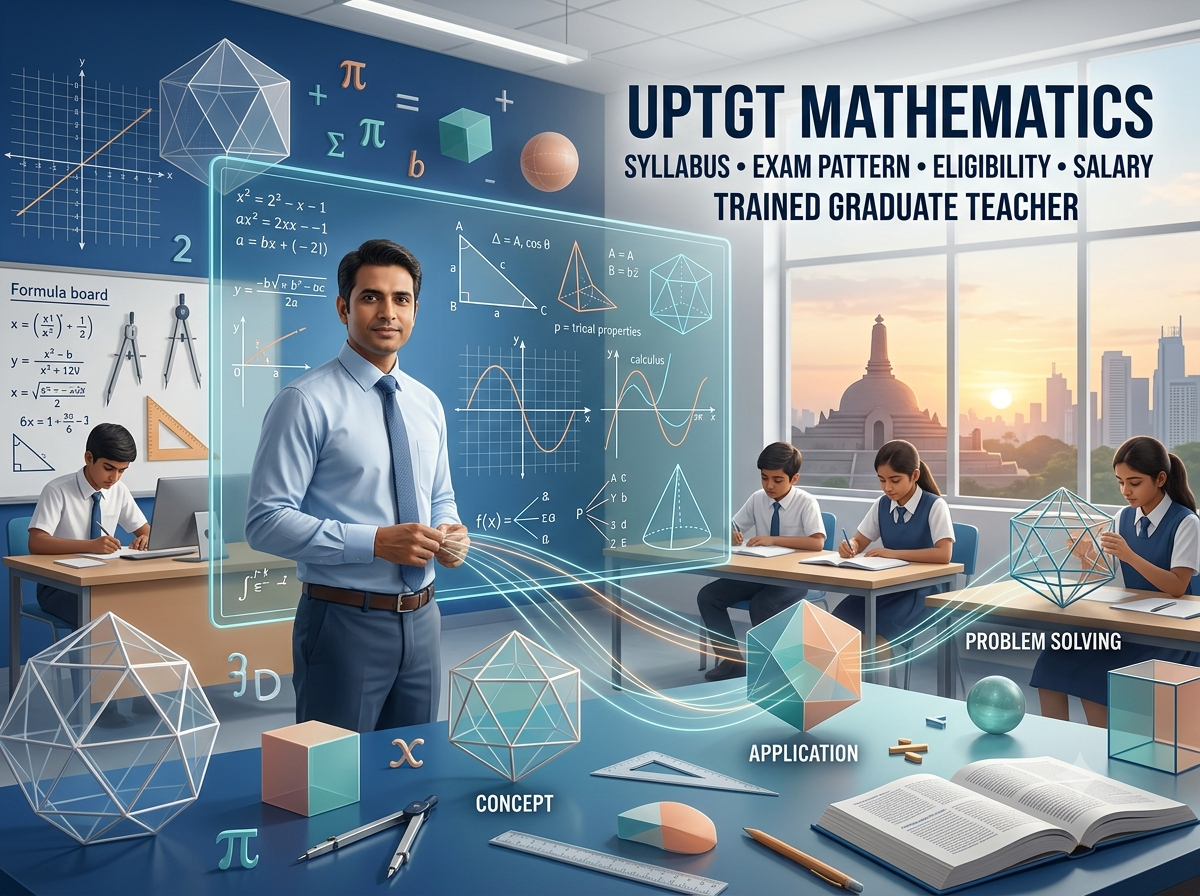
UPTGT Mathematics Exam: Syllabus, Exam Pattern, Eligibility, Salary & Preparation Strategy
If you are preparing for a government teaching job as a Mathematics teacher in Uttar Pradesh, the UPTGT Mathematics Exam is an important opportunity for teaching aspirants with the required academic and professional qualifications.
The UPTGT (Uttar Pradesh Trained Graduate Teacher) recruitment is conducted for teaching posts in Uttar Pradesh. For Mathematics candidates, a strong command of Algebra, Geometry, Trigonometry, Coordinate Geometry, Calculus, Statistics and other mathematical concepts is important, along with an understanding of effective teaching practices.
This complete guide covers the UPTGT Mathematics syllabus, exam pattern, eligibility, selection process, salary, preparation strategy and frequently asked questions.
Important: Recruitment rules, vacancies, eligibility conditions, syllabus and examination pattern may vary according to the applicable notification. Candidates should always check the latest official notification before applying.
UPTGT Mathematics Exam: Quick Overview
| Particular | Details |
|---|---|
| Exam Name | UPTGT Mathematics Recruitment |
| State | Uttar Pradesh |
| Post | Trained Graduate Teacher (TGT) – Mathematics |
| Subject | Mathematics |
| Job Type | Government Teaching Recruitment |
| Teaching Level | Secondary / Upper-Secondary Level as applicable |
| Exam Mode | As prescribed in the latest notification |
| Selection Process | As prescribed in the recruitment notification |
| Eligibility | Graduation in the concerned subject + prescribed teaching qualification |
| Job Location | Uttar Pradesh |
What is UPTGT Mathematics?
UPTGT Mathematics refers to the recruitment of Trained Graduate Teachers for Mathematics in Uttar Pradesh.
A Mathematics TGT is responsible for teaching mathematical concepts to students and helping them develop:
-
Mathematical reasoning
-
Problem-solving ability
-
Logical thinking
-
Numerical skills
-
Conceptual understanding
-
Analytical skills
Therefore, candidates should prepare not only formulas but also the concepts and applications of Mathematics.
UPTGT Mathematics Exam Pattern
The exact exam pattern should be checked in the latest official recruitment notification.
Candidates should pay attention to:
-
Total number of questions
-
Total marks
-
Examination duration
-
Question type
-
Marking scheme
-
Negative marking, if applicable
-
Subject-wise distribution
-
Selection criteria
For Mathematics aspirants, the concerned subject is the core area of preparation. Candidates should therefore devote sufficient time to conceptual understanding and question practice.
UPTGT Mathematics Syllabus
The Mathematics syllabus can broadly cover:
Algebra + Geometry + Trigonometry + Coordinate Geometry + Calculus + Statistics + Probability + Mensuration + Number System + Mathematical Reasoning
Let's understand the important areas.
UPTGT Mathematics Algebra Syllabus
Algebra is one of the fundamental areas of Mathematics preparation.
Important Topics
-
Sets
-
Relations and Functions
-
Number System
-
Polynomials
-
Algebraic Identities
-
Linear Equations
-
Quadratic Equations
-
Sequences and Series
-
Arithmetic Progression
-
Geometric Progression
-
Complex Numbers
-
Matrices
-
Determinants
-
Permutations and Combinations
-
Mathematical Induction
-
Binomial Theorem
Preparation Tip
Focus on understanding formulas along with their applications. Practise different question types instead of repeatedly solving only familiar problems.
UPTGT Mathematics Geometry Syllabus
Important Geometry topics include:
-
Lines and Angles
-
Triangles
-
Congruence
-
Similarity
-
Quadrilaterals
-
Circles
-
Polygons
-
Coordinate Geometry
-
Geometrical Theorems
-
Geometrical Constructions
Candidates should revise important theorems and practise numerical applications regularly.
UPTGT Mathematics Trigonometry Syllabus
Important topics include:
-
Trigonometric Ratios
-
Trigonometric Identities
-
Trigonometric Equations
-
Heights and Distances
-
Inverse Trigonometric Functions
-
Properties of Triangles
-
Applications of Trigonometry
A strong understanding of standard identities and their applications can help candidates solve questions efficiently.
UPTGT Mathematics Coordinate Geometry
Important topics include:
-
Cartesian Coordinates
-
Distance Formula
-
Section Formula
-
Slope of a Line
-
Equation of Straight Line
-
Pair of Straight Lines
-
Circle
-
Parabola
-
Ellipse
-
Hyperbola
Candidates should practise both formula-based and conceptual questions.
UPTGT Mathematics Calculus Syllabus
Important areas include:
Differential Calculus
-
Limits
-
Continuity
-
Differentiability
-
Derivatives
-
Applications of Derivatives
Integral Calculus
-
Indefinite Integration
-
Definite Integration
-
Applications of Integration
Differential Equations
-
Basic Differential Equations
-
Formation of Differential Equations
-
Solutions of Differential Equations
Regular practice is important because calculus questions can involve multiple concepts.
UPTGT Mathematics Statistics Syllabus
Important topics include:
-
Collection of Data
-
Classification of Data
-
Frequency Distribution
-
Mean
-
Median
-
Mode
-
Measures of Dispersion
-
Standard Deviation
-
Variance
-
Graphical Representation
-
Data Interpretation
Candidates should practise both calculations and interpretation-based questions.
UPTGT Mathematics Probability Syllabus
Important topics include:
-
Basic Probability
-
Events
-
Sample Space
-
Conditional Probability
-
Independent Events
-
Addition Theorem
-
Multiplication Theorem
-
Random Variables
-
Probability Distribution
Understand the basic concepts first and then move toward numerical practice.
UPTGT Mensuration Syllabus
Important topics include:
-
Perimeter
-
Area
-
Surface Area
-
Volume
-
Cubes
-
Cuboids
-
Cylinders
-
Cones
-
Spheres
-
Frustums
-
Composite Figures
Maintain a separate formula sheet for quick revision.
UPTGT Number System
Important topics include:
-
Natural Numbers
-
Whole Numbers
-
Integers
-
Rational Numbers
-
Irrational Numbers
-
Real Numbers
-
Divisibility
-
HCF and LCM
-
Simplification
-
Surds and Indices
UPTGT Mathematical Reasoning
Candidates should also prepare:
-
Logical Reasoning
-
Mathematical Statements
-
Statements and Arguments
-
Mathematical Logic
-
Patterns
-
Sequences
-
Problem Solving
-
Analytical Thinking
These topics help develop the logical approach required for mathematical problem-solving.
UPTGT Mathematics Teaching Methodology
A Mathematics teacher needs more than subject knowledge. Candidates should also understand how mathematical concepts can be effectively taught.
Important areas include:
-
Mathematics Teaching Methods
-
Child-Centred Learning
-
Activity-Based Learning
-
Learning by Doing
-
Problem-Solving Approach
-
Mathematical Reasoning
-
Classroom Management
-
Individual Differences
-
Learning Difficulties
-
Assessment and Evaluation
-
Remedial Teaching
-
Teaching-Learning Materials
-
ICT in Mathematics Education
-
Concept-Based Teaching
The focus should be on making mathematical concepts understandable, practical and engaging for students.
UPTGT Mathematics Eligibility
Eligibility conditions depend on the applicable recruitment notification.
Candidates generally need:
-
A Bachelor's Degree with the required subject combination
-
Prescribed teacher-training qualification such as B.Ed., wherever applicable
-
Required academic percentage, if specified
-
Age within the prescribed limit
-
Other post-specific qualifications
The subject combination in graduation is particularly important for subject-specific TGT recruitment.
Candidates should carefully check the official eligibility conditions before applying.
UPTGT Mathematics Age Limit
The age limit is prescribed in the applicable recruitment notification.
Age relaxation may be available to eligible candidates according to applicable government rules.
Candidates should check:
-
Maximum Age
-
Minimum Age
-
Cut-off Date
-
Category-wise Relaxation
-
Applicable Government Rules
UPTGT Mathematics Selection Process
The selection process depends on the applicable recruitment notification.
It may include:
Stage 1: Written Examination
Candidates appear for the prescribed written examination.
Stage 2: Document Verification
Shortlisted candidates may be required to provide:
-
Educational Certificates
-
Graduation Mark Sheets
-
B.Ed. / Teacher Training Certificate
-
Age Proof
-
Category Certificate
-
Identity Proof
-
Other Required Documents
Stage 3: Final Selection
Final selection is made according to the applicable recruitment rules and merit criteria.
Candidates should check the latest notification for the exact selection procedure.
UPTGT Mathematics Salary
The salary and pay structure depend on the applicable recruitment rules and notification.
The overall compensation may include:
-
Basic Pay
-
Dearness Allowance
-
House Rent Allowance
-
Other Applicable Allowances
-
Medical Benefits
-
Leave Benefits
-
Retirement Benefits
Candidates should refer to the latest official notification for the exact pay scale and applicable allowances.
How to Prepare for UPTGT Mathematics?
A successful preparation strategy should follow:
CONCEPT → PRACTICE → PYQ → MOCK TEST → ANALYSIS → REVISION
Step 1: Understand the Syllabus
Start with the latest official Mathematics syllabus.
Divide it into:
-
Algebra
-
Geometry
-
Trigonometry
-
Coordinate Geometry
-
Calculus
-
Statistics
-
Probability
-
Mensuration
-
Number System
-
Mathematical Reasoning
Step 2: Build Strong Fundamentals
Start with basic concepts before moving toward difficult questions.
Understand the logic behind every formula instead of memorising formulas blindly.
Step 3: Practise Questions
After completing every topic, solve a sufficient number of questions.
Focus on:
-
Accuracy
-
Speed
-
Different question types
-
Application-based problems
Step 4: Solve Previous Year Questions
PYQs help you understand:
-
Question Pattern
-
Important Topics
-
Difficulty Level
-
Repeated Concepts
-
Time Management
Step 5: Attempt Mock Tests
Take sectional tests first and gradually move toward full-length tests.
After every mock test, analyse:
Wrong Questions + Unattempted Questions + Time-Consuming Questions
Step 6: Revise Regularly
Create short notes for:
-
Important Formulas
-
Theorems
-
Short Tricks
-
Difficult Concepts
-
Common Mistakes
UPTGT Mathematics 90-Day Preparation Plan
| Phase | Focus |
|---|---|
| Days 1–30 | Basic Concepts + Core Mathematics |
| Days 31–60 | Advanced Topics + Question Practice |
| Days 61–75 | PYQs + Full Syllabus Revision |
| Days 76–90 | Mock Tests + Final Revision |
Suggested Daily Routine
| Study Area | Suggested Work |
|---|---|
| Mathematics | Concepts + Questions |
| Formula Revision | Daily Revision |
| PYQs | Topic-Wise Practice |
| Difficult Topics | Extra Practice |
| Mock Test | Regular Tests |
| Error Analysis | Mistake Notebook |
| Revision | Short Notes |
UPTGT Mathematics Preparation Strategy
1. Give Priority to Conceptual Clarity
Mathematics becomes easier when concepts are clear.
2. Maintain a Formula Notebook
Keep important formulas, identities and theorems in one place.
3. Practise Daily
Regular practice is more useful than studying Mathematics only occasionally.
4. Solve PYQs
Use previous year questions as an important part of preparation.
5. Improve Calculation Speed
Practise calculations regularly to reduce the time spent on numerical questions.
6. Analyse Your Mistakes
Maintain a separate mistake notebook and revise it regularly.
Common Mistakes to Avoid
Mistake 1: Only Memorising Formulas
Understanding the application of a formula is equally important.
Mistake 2: Ignoring Difficult Topics
Do not leave entire chapters untouched. Break difficult topics into smaller concepts.
Mistake 3: Skipping PYQs
Previous year questions provide valuable exam-oriented practice.
Mistake 4: Not Taking Mock Tests
Mock tests help improve speed and time management.
Mistake 5: Not Revising Formulas
Regular formula revision can improve recall during the examination.
UPTGT Mathematics Preparation with TDC Classes
Preparing for UPTGT Mathematics requires strong conceptual knowledge, regular practice and an exam-oriented approach.
At TDC Classes, teaching aspirants can follow a structured preparation approach with:
-
Concept-Based Mathematics Classes
-
Experienced Faculty
-
Topic-Wise Practice
-
PYQ-Based Learning
-
Regular Test Series
-
Study Material
-
Doubt Support
-
Formula Revision
-
Mock Tests
-
Exam-Oriented Guidance
TDC Classes focuses on helping teaching aspirants build strong Mathematics fundamentals and prepare systematically for government teaching examinations.
UPTGT Mathematics Frequently Asked Questions
Q1. What is UPTGT Mathematics?
UPTGT Mathematics is the recruitment examination/process for Trained Graduate Teacher Mathematics posts in Uttar Pradesh, as notified by the concerned recruiting authority.
Q2. What subjects are important for UPTGT Mathematics?
Major Mathematics areas include Algebra, Geometry, Trigonometry, Coordinate Geometry, Calculus, Statistics, Probability, Mensuration, Number System and Mathematical Reasoning.
Q3. What qualification is required for UPTGT Mathematics?
Candidates must fulfil the educational and teacher-training qualifications prescribed in the applicable recruitment notification.
Q4. Is B.Ed. required for UPTGT Mathematics?
The teacher-training qualification requirement should be checked in the applicable official recruitment notification.
Q5. Is there negative marking in UPTGT?
The marking scheme, including negative marking if applicable, should be verified from the latest official notification.
Q6. How can I prepare for UPTGT Mathematics?
Understand the complete syllabus, build strong concepts, practise Mathematics regularly, solve PYQs, take mock tests and revise formulas consistently.
Q7. Which Mathematics topics should I study first?
Start with fundamental areas such as Number System, Algebra, Geometry and Trigonometry, and then move toward advanced areas according to the syllabus.
Q8. How important are previous year questions?
PYQs are useful for understanding question patterns, important concepts and the level of preparation required.
Q9. How can I improve Mathematics speed?
Practise regularly, revise formulas and solve timed question sets.
Q10. Where can I check the latest UPTGT Mathematics notification?
Candidates should refer to the official website and latest recruitment notification of the concerned Uttar Pradesh recruiting authority for vacancies, eligibility, syllabus, application dates and examination details.
Final Words
The UPTGT Mathematics Exam is an important opportunity for candidates who want to build a teaching career in Uttar Pradesh.
A strong preparation plan should focus on:
Mathematics Concepts + Formula Revision + Question Practice + PYQs + Mock Tests + Error Analysis
Start with the latest official syllabus, divide the topics into manageable targets and maintain consistent revision.
Remember:
Learn the Concept → Practise Questions → Solve PYQs → Take Mock Tests → Analyse Mistakes → Revise
TDC Classes — Learn. Practice. Revise. Achieve.