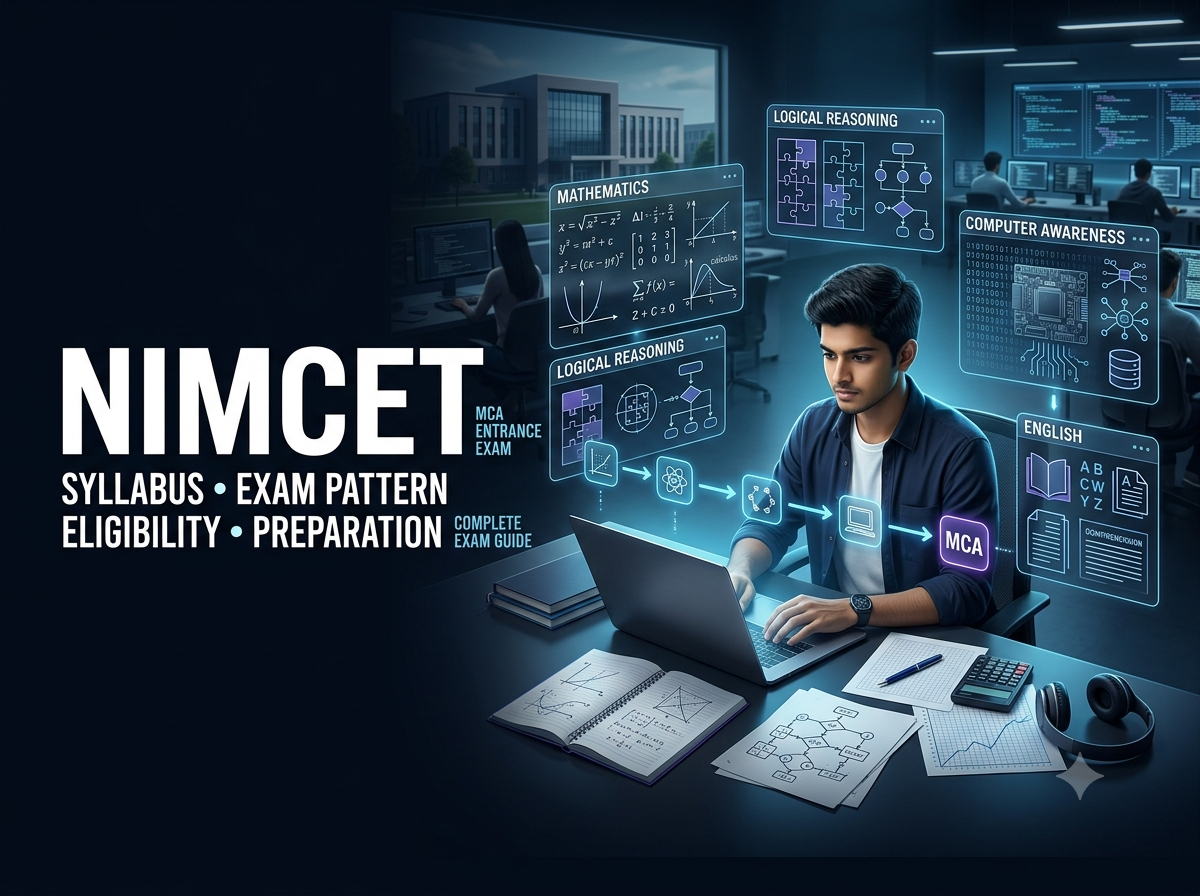
NIMCET: Syllabus, Exam Pattern, Eligibility, Colleges, Preparation Strategy & FAQs
Are you planning to pursue an MCA from one of the leading National Institutes of Technology (NITs)? The NIT MCA Common Entrance Test (NIMCET) is an important entrance examination for candidates seeking admission to MCA programmes offered through participating NITs and other institutes under the NIMCET admission process.
NIMCET primarily tests a candidate's ability in Mathematics, Analytical Ability & Logical Reasoning, Computer Awareness and General English. A smart preparation strategy, strong mathematical fundamentals and regular mock-test practice can make your preparation more structured and effective.
In this complete guide, you will find information about the NIMCET syllabus, exam pattern, eligibility, marking scheme, admission process, preparation strategy, important topics and frequently asked questions.
Important: NIMCET participating institutes, eligibility rules, examination pattern, syllabus, application dates and admission procedures may be updated from time to time. Candidates should always check the latest official NIMCET notification and information brochure before applying.
NIMCET: Quick Overview
| Particular | Details |
|---|---|
| Exam Name | NIT MCA Common Entrance Test (NIMCET) |
| Course | Master of Computer Applications (MCA) |
| Exam Type | National-Level Entrance Examination |
| Conducting Authority | As specified in the latest NIMCET notification |
| Exam Mode | Computer-Based Test |
| Main Subjects | Mathematics, Analytical Ability & Logical Reasoning, Computer Awareness, General English |
| Admission | MCA at Participating NITs / Institutes |
| Question Type | Multiple Choice Questions |
| Admission Basis | NIMCET Rank / Applicable Admission Process |
What is NIMCET?
NIMCET stands for NIT MCA Common Entrance Test.
It is a national-level entrance examination used for admission to the MCA programme at participating NITs and other institutes included in the NIMCET admission process.
For students interested in computer applications, programming, software development and technology careers, MCA can provide a structured path toward advanced study in computing.
NIMCET preparation requires special attention to Mathematics because it forms a significant part of the examination.
NIMCET Exam Pattern
The NIMCET examination consists of multiple-choice questions from four major areas:
-
Mathematics
-
Analytical Ability & Logical Reasoning
-
Computer Awareness
-
General English
The exact number of questions, marks, duration and marking scheme should be verified from the latest official information brochure because the examination pattern may be revised.
Candidates should particularly keep track of:
-
Total Questions
-
Total Marks
-
Section-wise Weightage
-
Examination Duration
-
Marking Scheme
-
Negative Marking
-
Computer-Based Test Format
NIMCET Syllabus
The NIMCET syllabus can broadly be divided into four major sections:
MATHEMATICS + ANALYTICAL ABILITY & LOGICAL REASONING + COMPUTER AWARENESS + GENERAL ENGLISH
Let's explore the important topics in each section.
NIMCET Mathematics Syllabus
Mathematics is a major component of NIMCET preparation.
Important Topics
-
Set Theory
-
Probability
-
Statistics
-
Algebra
-
Coordinate Geometry
-
Calculus
-
Trigonometry
-
Vectors
-
Matrices
-
Determinants
-
Permutations and Combinations
-
Sequence and Series
-
Logarithms
-
Quadratic Equations
-
Complex Numbers
-
Functions
-
Relations
-
Mathematical Reasoning
Algebra
Focus on:
-
Equations
-
Inequalities
-
Progressions
-
Functions
-
Logarithms
-
Complex Numbers
-
Matrices
-
Determinants
Coordinate Geometry
Important areas include:
-
Straight Lines
-
Circles
-
Parabola
-
Ellipse
-
Hyperbola
-
Distance Formula
-
Section Formula
-
Slope
Calculus
Important topics include:
-
Limits
-
Continuity
-
Differentiation
-
Applications of Derivatives
-
Integration
-
Applications of Integration
Probability & Statistics
Prepare:
-
Basic Probability
-
Events
-
Conditional Probability
-
Mean
-
Median
-
Mode
-
Variance
-
Standard Deviation
-
Data Interpretation
NIMCET Analytical Ability & Logical Reasoning
This section tests analytical thinking and logical problem-solving ability.
Important Topics
-
Number Series
-
Letter Series
-
Coding-Decoding
-
Blood Relations
-
Direction Sense
-
Seating Arrangement
-
Syllogism
-
Statement and Conclusion
-
Analogy
-
Classification
-
Puzzles
-
Logical Deductions
-
Data Interpretation
-
Data Sufficiency
-
Venn Diagrams
-
Ranking and Ordering
-
Pattern Recognition
Preparation Tip
Instead of simply memorising shortcuts, understand the logic behind each question type and practise questions under time limits.
NIMCET Computer Awareness Syllabus
Computer Awareness tests fundamental knowledge of computers and information technology.
Important Topics
-
Computer Fundamentals
-
Computer Organisation
-
Operating Systems
-
Input and Output Devices
-
Memory
-
Storage Devices
-
Number Systems
-
Binary Numbers
-
Computer Networks
-
Internet
-
Programming Fundamentals
-
Data Structures Basics
-
Database Fundamentals
-
MS Office Basics
-
Computer Security
-
Software and Hardware
-
Algorithms Basics
Candidates should focus on fundamental concepts rather than highly advanced programming.
NIMCET General English Syllabus
The English section generally tests language and comprehension skills.
Important Topics
-
Vocabulary
-
Synonyms
-
Antonyms
-
Grammar
-
Sentence Correction
-
Fill in the Blanks
-
Reading Comprehension
-
Idioms and Phrases
-
One-Word Substitution
-
Sentence Arrangement
-
Error Detection
-
Basic Usage of English
Preparation Tip
Read English articles and editorials regularly and maintain a vocabulary notebook for new words.
NIMCET Eligibility
Eligibility requirements are determined according to the latest NIMCET rules.
Candidates generally need to fulfil the prescribed requirements related to:
-
Educational Qualification
-
Mathematics / Statistics requirement
-
Graduation
-
Minimum Marks
-
Citizenship / Residency requirements, wherever applicable
-
Other conditions specified in the information brochure
A candidate's Mathematics or Statistics background is particularly important for NIMCET eligibility.
Since eligibility rules can change, candidates should carefully verify the latest official notification before applying.
NIMCET Admission Process
The NIMCET admission process generally involves:
Step 1: Online Application
Candidates register online and submit the required details and documents.
Step 2: Entrance Examination
Eligible candidates appear for the NIMCET examination.
Step 3: Rank / Result
Candidates receive their examination result and rank according to the applicable evaluation process.
Step 4: Choice Filling
Eligible candidates participate in the counselling or choice-filling process and select available institutes/programmes according to the applicable rules.
Step 5: Seat Allotment
Seats are allotted based on rank, choices, availability and applicable reservation rules.
Step 6: Institute Reporting
Candidates complete admission formalities at the allotted institute.
NIMCET Participating Institutes
NIMCET provides an admission route to MCA programmes at participating NITs and other institutes included in the admission process.
The participating institute list can change between admission cycles.
Candidates should check the latest official NIMCET information brochure for the current list of participating institutes and available MCA seats.
NIMCET Preparation Strategy
A smart preparation formula is:
CONCEPT → PRACTICE → PYQ → MOCK TEST → ANALYSIS → REVISION
Step 1: Understand the Syllabus
Divide the syllabus into:
-
Mathematics
-
Logical Reasoning
-
Computer Awareness
-
English
Create a topic-wise preparation checklist.
Step 2: Strengthen Mathematics
Spend consistent time on Mathematics because strong fundamentals are essential for solving questions accurately and quickly.
Step 3: Practise Reasoning Daily
Solve a fixed number of reasoning questions every day.
Focus on speed and accuracy.
Step 4: Revise Computer Fundamentals
Prepare short notes covering important computer concepts, terminology and fundamentals.
Step 5: Improve English
Read regularly and practise comprehension, vocabulary and grammar questions.
Step 6: Solve Previous Questions
Use previous examination questions and relevant practice sets to understand the nature of questions.
Step 7: Attempt Mock Tests
Regular full-length tests can help improve:
-
Speed
-
Accuracy
-
Time Management
-
Question Selection
-
Exam Confidence
NIMCET 90-Day Preparation Plan
| Phase | Preparation Focus |
|---|---|
| Days 1–30 | Mathematics Fundamentals + Reasoning Basics |
| Days 31–50 | Advanced Mathematics + Computer Awareness |
| Days 51–65 | English + Mixed Question Practice |
| Days 66–75 | Previous Questions + Sectional Tests |
| Days 76–90 | Full-Length Mocks + Revision |
Suggested Daily Routine
| Study Area | Focus |
|---|---|
| Mathematics | Concepts + Problem Solving |
| Reasoning | Daily Practice |
| Computer | Concept Revision |
| English | Vocabulary + Comprehension |
| PYQs | Topic-Wise Practice |
| Mock Tests | Regular Tests |
| Revision | Formula + Short Notes |
NIMCET Mathematics Preparation Tips
Mathematics can be a key area of preparation.
Focus on:
-
Formula Revision
-
Concept Clarity
-
Calculation Speed
-
Shortcuts
-
Timed Practice
-
Mixed Question Sets
-
Previous Questions
Maintain a separate notebook for:
Formulas + Short Tricks + Important Concepts + Mistakes
NIMCET Reasoning Preparation Tips
For reasoning:
-
Understand the basic approach.
-
Practise different question patterns.
-
Use timed practice.
-
Identify your weak topics.
-
Revise frequently used methods.
Regular practice can significantly improve solving speed.
NIMCET Computer Awareness Preparation Tips
Focus on fundamental concepts such as:
-
Hardware
-
Software
-
Operating Systems
-
Memory
-
Networking
-
Internet
-
Number Systems
-
Databases
-
Programming Basics
-
Computer Security
Create short revision notes for important definitions and concepts.
NIMCET English Preparation Tips
Improve English through consistent practice.
Daily Practice
-
Learn new vocabulary
-
Read English articles
-
Solve comprehension passages
-
Practise grammar
-
Revise synonyms and antonyms
-
Solve sentence correction questions
Common Mistakes to Avoid in NIMCET Preparation
Mistake 1: Ignoring Mathematics
Mathematics requires consistent preparation. Leaving it for the final weeks can make preparation difficult.
Mistake 2: Studying Without a Plan
Create weekly and monthly targets instead of studying randomly.
Mistake 3: Avoiding Timed Practice
Speed matters in a competitive entrance examination.
Mistake 4: Skipping Mock Tests
Mock tests help identify weak areas and improve time management.
Mistake 5: Not Analysing Mistakes
After every test, review incorrect and unattempted questions.
Mistake 6: Ignoring Basic Computer Concepts
Computer Awareness does not necessarily require advanced programming. Strong fundamentals are important.
NIMCET Preparation with TDC Classes
Preparing for NIMCET requires a structured approach covering Mathematics, Analytical Ability & Logical Reasoning, Computer Awareness and General English.
At TDC Classes, students can follow an organised preparation strategy with:
-
Concept-Based Classes
-
Experienced Faculty
-
Mathematics Preparation
-
Reasoning Practice
-
Computer Awareness Classes
-
English Preparation
-
PYQ-Based Practice
-
Regular Test Series
-
Study Material
-
Doubt Support
-
Mock Tests
-
Revision Strategy
-
Exam-Oriented Guidance
TDC Classes focuses on helping aspirants strengthen their fundamentals and prepare systematically for competitive entrance examinations.
NIMCET Frequently Asked Questions
Q1. What is NIMCET?
NIMCET stands for NIT MCA Common Entrance Test. It is an entrance examination used for admission to MCA programmes at participating NITs and other institutes included in the NIMCET admission process.
Q2. What course is offered through NIMCET?
NIMCET is conducted for admission to MCA programmes.
Q3. What subjects are included in NIMCET?
The major areas are:
-
Mathematics
-
Analytical Ability & Logical Reasoning
-
Computer Awareness
-
General English
Q4. Is Mathematics important for NIMCET?
Yes. Mathematics is a major component of the examination and also plays an important role in preparation.
Q5. Who is eligible for NIMCET?
Candidates who fulfil the educational, Mathematics/Statistics and other eligibility requirements specified in the latest official NIMCET notification can apply.
Q6. Is a Mathematics background required for NIMCET?
The applicable eligibility rules prescribe requirements related to Mathematics or Statistics. Candidates should check the latest official information brochure for exact conditions.
Q7. Does NIMCET guarantee admission to an NIT?
No. Admission depends on the candidate's NIMCET rank, choices, seat availability, eligibility and applicable counselling rules.
Q8. How should I prepare for NIMCET?
Start with the syllabus, strengthen Mathematics, practise reasoning, revise computer fundamentals, improve English, solve previous questions and take regular mock tests.
Q9. How important are mock tests for NIMCET?
Mock tests are useful for improving speed, accuracy, time management and question-selection skills.
Q10. Where can I check the latest NIMCET notification?
Candidates should refer to the official NIMCET website and the latest information brochure for current application dates, eligibility, syllabus, exam pattern, participating institutes and admission rules.
Final Words
NIMCET is an important entrance examination for students aiming to pursue an MCA through participating NITs and institutes.
A focused preparation strategy should cover:
Mathematics + Reasoning + Computer Awareness + English + PYQs + Mock Tests + Revision
Follow a simple preparation cycle:
Learn → Practise → Solve PYQs → Take Mock Tests → Analyse → Revise
Start your preparation with the latest syllabus, strengthen your fundamentals and maintain regular practice throughout your preparation journey.
TDC Classes — Learn. Practice. Revise. Achieve.