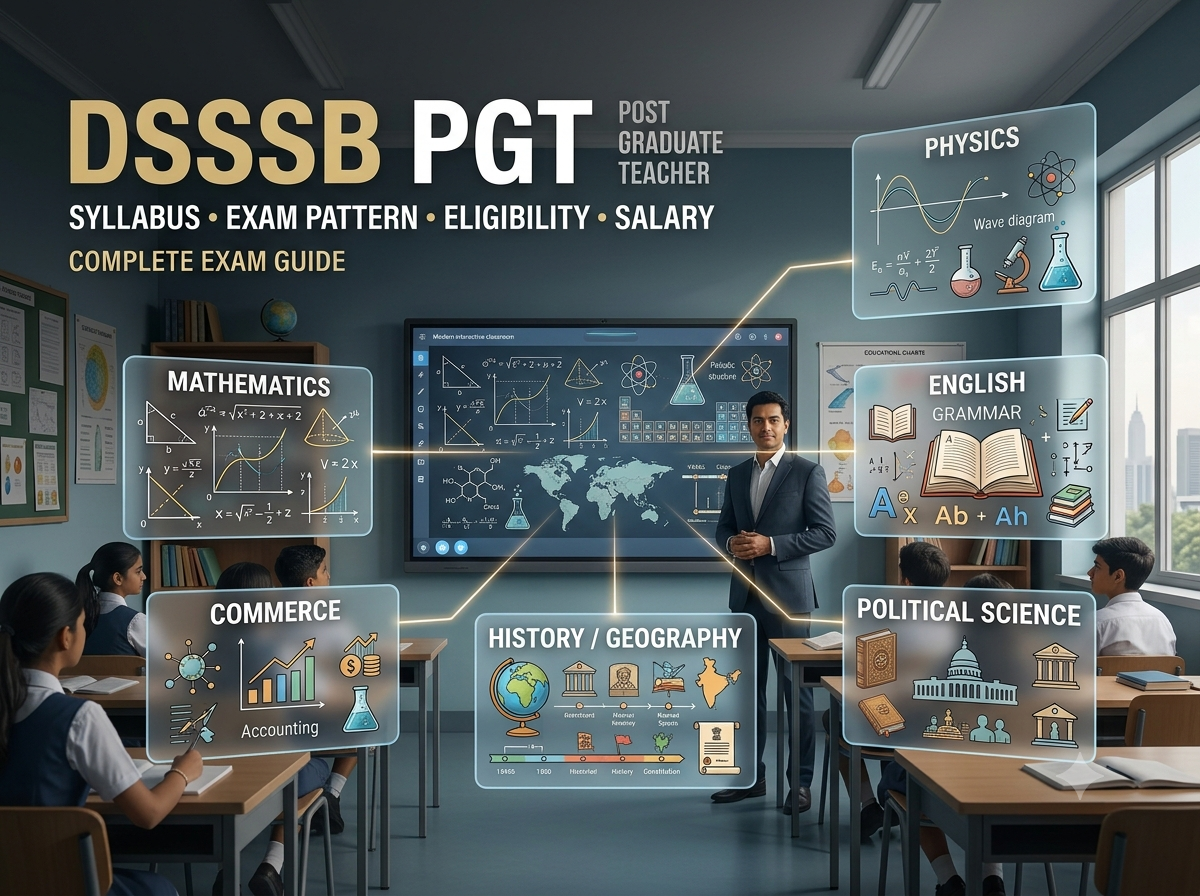
DSSSB PGT Exam: Syllabus, Exam Pattern, Eligibility, Salary & Preparation Strategy
Are you aiming for a Post Graduate Teacher (PGT) government teaching job in Delhi? The DSSSB PGT Exam is an important recruitment opportunity for candidates who have postgraduate-level subject knowledge along with the prescribed teaching qualification.
The Delhi Subordinate Services Selection Board (DSSSB) conducts recruitment for various teaching and non-teaching posts under the Government of NCT of Delhi and other concerned organizations, whenever vacancies are notified.
PGT teachers generally teach students at the senior secondary level. Therefore, the examination places significant importance on subject-specific knowledge, teaching methodology and educational understanding.
This complete guide covers the DSSSB PGT syllabus, exam pattern, subject-wise syllabus, eligibility criteria, selection process, salary, preparation strategy and frequently asked questions.
Important: DSSSB recruitment conditions, vacancies, subjects, eligibility criteria, syllabus and examination pattern can change between recruitment cycles. Candidates should always check the latest official notification before applying.
DSSSB PGT Exam: Quick Overview
| Particular | Details |
|---|---|
| Exam Name | DSSSB Post Graduate Teacher Recruitment |
| Organization | Delhi Subordinate Services Selection Board |
| Post | Post Graduate Teacher (PGT) |
| Job Location | Delhi |
| Recruitment Type | Government Teaching Recruitment |
| Exam Mode | Computer-Based Examination |
| Teaching Level | Senior Secondary / Postgraduate-level subject teaching as applicable |
| Subjects | Multiple Subjects |
| Selection Process | As prescribed in the latest notification |
| Eligibility | Postgraduate Degree + prescribed teaching qualification and other conditions |
| Official Authority | DSSSB |
What is DSSSB PGT?
DSSSB PGT stands for Delhi Subordinate Services Selection Board Post Graduate Teacher.
PGT teachers generally teach students at the senior secondary level. They are expected to have strong command over their respective subjects as well as an understanding of effective teaching practices.
DSSSB may notify PGT vacancies for subjects such as:
-
English
-
Hindi
-
Mathematics
-
Physics
-
Chemistry
-
Biology
-
Commerce
-
Economics
-
History
-
Geography
-
Political Science
-
Computer Science
-
Other subjects as notified
The availability of subjects and number of vacancies depend on the specific recruitment notification.
DSSSB PGT Exam Pattern
The exact examination pattern is prescribed in the applicable DSSSB notification.
Candidates should check the official notification for:
-
Number of questions
-
Total marks
-
Examination duration
-
Section-wise weightage
-
Subject-specific questions
-
Negative marking
-
Qualifying criteria
-
Selection procedure
The preparation can generally be divided into:
General Section
Depending on the applicable examination scheme, this may cover:
-
General Awareness
-
General Intelligence & Reasoning
-
Numerical Ability
-
Hindi Language
-
English Language
Subject / Professional Section
This section focuses on:
-
Concerned postgraduate-level subject
-
Subject-specific concepts
-
Teaching methodology
-
Educational understanding
-
Professional knowledge
Candidates should follow the exact weightage and syllabus mentioned in the latest recruitment notification.
DSSSB PGT Syllabus
The DSSSB PGT syllabus can broadly be divided into:
General Awareness + Reasoning + Numerical Ability + Hindi + English + Teaching/Professional Knowledge + Concerned Subject
The concerned subject is one of the most important components of PGT preparation.
DSSSB PGT General Awareness Syllabus
Important topics include:
-
Indian History
-
Indian Geography
-
Indian Polity
-
Indian Economy
-
General Science
-
Environment
-
Current Affairs
-
Sports
-
Awards and Honours
-
Books and Authors
-
Important Days
-
Government Schemes
-
Science & Technology
-
National Events
-
International Events
Delhi General Awareness
Candidates should also keep themselves updated with:
-
Delhi-related current affairs
-
Important institutions
-
Delhi Government initiatives
-
Important places
-
Major developments in Delhi
DSSSB PGT Reasoning Syllabus
Important reasoning topics include:
-
Analogy
-
Classification
-
Coding-Decoding
-
Number Series
-
Alphabet Series
-
Blood Relations
-
Direction Sense
-
Ranking
-
Syllogism
-
Venn Diagrams
-
Statement and Conclusions
-
Assertion and Reason
-
Data Sufficiency
-
Puzzles
-
Seating Arrangement
-
Logical Reasoning
-
Non-Verbal Reasoning
Regular practice is important for improving speed and accuracy.
DSSSB PGT Numerical Ability Syllabus
Candidates should prepare:
-
Number System
-
Simplification
-
Percentage
-
Ratio and Proportion
-
Average
-
Profit and Loss
-
Simple Interest
-
Compound Interest
-
Time and Work
-
Time, Speed and Distance
-
Algebra
-
Geometry
-
Mensuration
-
Data Interpretation
-
Probability
-
Basic Arithmetic
Candidates should focus on both concepts and calculation speed.
DSSSB PGT English Syllabus
Important topics include:
-
Parts of Speech
-
Tenses
-
Articles
-
Prepositions
-
Subject-Verb Agreement
-
Active and Passive Voice
-
Direct and Indirect Speech
-
Error Detection
-
Sentence Improvement
-
Fill in the Blanks
-
Synonyms
-
Antonyms
-
One Word Substitution
-
Idioms and Phrases
-
Reading Comprehension
-
Cloze Test
-
Vocabulary
DSSSB PGT Hindi Syllabus
Important Hindi topics include:
-
संज्ञा
-
सर्वनाम
-
विशेषण
-
क्रिया
-
काल
-
वचन
-
लिंग
-
संधि
-
समास
-
उपसर्ग
-
प्रत्यय
-
पर्यायवाची शब्द
-
विलोम शब्द
-
मुहावरे
-
लोकोक्तियाँ
-
वाक्य शुद्धि
-
शब्द शुद्धि
-
गद्यांश
-
वर्तनी
DSSSB PGT Teaching & Educational Methodology
PGT aspirants should understand how effective teaching is planned and delivered at the senior secondary level.
Important topics include:
-
Educational Psychology
-
Learning Theories
-
Individual Differences
-
Intelligence
-
Personality
-
Motivation
-
Classroom Management
-
Inclusive Education
-
Assessment and Evaluation
-
Curriculum Development
-
Teaching Methods
-
Educational Technology
-
ICT in Education
-
Learner-Centred Education
-
Critical Thinking
-
Problem-Solving
-
Remedial Teaching
-
Guidance and Counselling
A PGT teacher is expected to handle subject-specific concepts while also understanding the learning needs of students.
DSSSB PGT Subject-Wise Syllabus
The subject-specific syllabus varies according to the PGT post.
Candidates should prepare the subject for which they are applying and carefully check the official syllabus.
DSSSB PGT English Syllabus
Important areas include:
English Language
-
Grammar
-
Vocabulary
-
Comprehension
-
Sentence Structure
-
Communication Skills
English Literature
-
Poetry
-
Prose
-
Drama
-
Fiction
-
Literary Criticism
-
Literary Terms
-
Major Writers and Works
-
Literary Movements
-
Indian Writing in English
Teaching Methodology
-
Teaching English
-
Language Skills
-
Reading
-
Writing
-
Listening
-
Speaking
-
Assessment
-
Classroom Activities
DSSSB PGT Hindi Syllabus
Important areas include:
हिंदी भाषा
-
व्याकरण
-
शब्द ज्ञान
-
वाक्य रचना
-
गद्य
-
पद्य
-
अपठित गद्यांश
हिंदी साहित्य
-
काव्य
-
गद्य
-
प्रमुख लेखक
-
प्रमुख रचनाएँ
-
साहित्यिक विधाएँ
-
साहित्यिक प्रवृत्तियाँ
-
साहित्य का इतिहास
शिक्षण पद्धति
-
हिंदी भाषा शिक्षण
-
भाषा कौशल
-
पठन
-
लेखन
-
मूल्यांकन
-
शिक्षण विधियाँ
DSSSB PGT Mathematics Syllabus
Mathematics candidates should focus on:
Algebra
-
Sets
-
Relations and Functions
-
Complex Numbers
-
Matrices
-
Determinants
-
Polynomial Equations
-
Sequences and Series
Calculus
-
Limits
-
Continuity
-
Differentiation
-
Applications of Derivatives
-
Integration
-
Differential Equations
Coordinate Geometry
-
Straight Lines
-
Circles
-
Conic Sections
-
Three-Dimensional Geometry
Probability & Statistics
-
Probability
-
Random Variables
-
Statistical Measures
-
Distribution Concepts
Vector Algebra
-
Vectors
-
Vector Operations
-
Applications
Mathematics Pedagogy
-
Teaching Methods
-
Problem Solving
-
Mathematical Reasoning
-
Assessment
-
Learning Difficulties
DSSSB PGT Physics Syllabus
Important areas include:
-
Mathematical Physics
-
Mechanics
-
Properties of Matter
-
Oscillations
-
Waves
-
Thermodynamics
-
Kinetic Theory
-
Electrostatics
-
Current Electricity
-
Magnetism
-
Electromagnetic Induction
-
Alternating Current
-
Electromagnetic Waves
-
Optics
-
Dual Nature
-
Atomic Physics
-
Nuclear Physics
-
Semiconductor Electronics
DSSSB PGT Chemistry Syllabus
Important topics include:
Physical Chemistry
-
Atomic Structure
-
Chemical Bonding
-
Thermodynamics
-
Equilibrium
-
Electrochemistry
-
Chemical Kinetics
-
Solutions
-
Surface Chemistry
Organic Chemistry
-
Basic Organic Chemistry
-
Hydrocarbons
-
Haloalkanes
-
Alcohols
-
Phenols
-
Ethers
-
Aldehydes
-
Ketones
-
Carboxylic Acids
-
Amines
-
Biomolecules
-
Polymers
Inorganic Chemistry
-
Periodic Classification
-
Coordination Chemistry
-
s-Block
-
p-Block
-
d-Block
-
Metallurgy
-
Chemical Bonding
DSSSB PGT Biology Syllabus
Important topics include:
-
Cell Biology
-
Biomolecules
-
Genetics
-
Evolution
-
Plant Physiology
-
Human Physiology
-
Reproduction
-
Ecology
-
Biotechnology
-
Molecular Biology
-
Diversity of Living Organisms
-
Microbiology
-
Environmental Biology
DSSSB PGT Commerce Syllabus
Important areas include:
Accountancy
-
Financial Accounting
-
Partnership Accounts
-
Company Accounts
-
Analysis of Financial Statements
-
Accounting Principles
Business Studies
-
Business Organisation
-
Management
-
Marketing
-
Finance
-
Human Resource Management
-
Business Environment
Economics
-
Microeconomics
-
Macroeconomics
-
National Income
-
Money and Banking
-
Public Finance
-
Indian Economy
DSSSB PGT Economics Syllabus
Important topics include:
-
Microeconomics
-
Macroeconomics
-
Demand and Supply
-
Consumer Behaviour
-
Production
-
Market Structures
-
National Income
-
Money and Banking
-
Inflation
-
Public Finance
-
International Trade
-
Indian Economy
-
Economic Development
DSSSB PGT History Syllabus
Important areas include:
-
Ancient Indian History
-
Medieval Indian History
-
Modern Indian History
-
Indian National Movement
-
World History
-
European History
-
Colonialism
-
Industrial Revolution
-
Major Historical Events
-
Historical Sources
-
Historiography
DSSSB PGT Geography Syllabus
Important topics include:
-
Physical Geography
-
Human Geography
-
Indian Geography
-
Economic Geography
-
Population Geography
-
Resources
-
Agriculture
-
Industries
-
Climate
-
Environmental Geography
-
Geomorphology
-
Oceanography
-
Map-Based Concepts
DSSSB PGT Political Science Syllabus
Important topics include:
-
Political Theory
-
Indian Constitution
-
Indian Government
-
Parliament
-
Judiciary
-
Executive
-
Federalism
-
Democracy
-
Rights and Duties
-
Political Institutions
-
International Relations
-
Comparative Politics
-
Public Administration
DSSSB PGT Computer Science Syllabus
Important areas include:
-
Programming
-
Data Structures
-
Algorithms
-
Database Management Systems
-
Operating Systems
-
Computer Networks
-
Computer Organization
-
Object-Oriented Programming
-
Web Technologies
-
Software Engineering
-
Computer Security
-
Data Communication
DSSSB PGT Eligibility Criteria
The eligibility requirements vary according to the subject and recruitment notification.
Candidates generally need:
-
Postgraduate Degree in the concerned subject
-
Prescribed teacher-training qualification
-
Required subject combination
-
Age within the prescribed limit
-
Other post-specific qualifications
For certain subjects, the required postgraduate degree and subject combination can be different.
Therefore, candidates must carefully check the post-wise eligibility table in the official DSSSB notification before applying.
DSSSB PGT Age Limit
The age limit is prescribed in the relevant recruitment notification.
Age relaxation may be available to eligible candidates according to applicable government rules.
Candidates should verify:
-
Maximum Age
-
Cut-off Date
-
Category-wise Relaxation
-
Applicable Rules
DSSSB PGT Selection Process
The selection process depends on the recruitment notification.
It may include:
Stage 1: Computer-Based Examination
Candidates appear for the prescribed written examination.
Stage 2: Document Verification
Shortlisted candidates may need to provide:
-
Postgraduate Degree
-
Mark Sheets
-
B.Ed. / Prescribed Teaching Qualification
-
Age Proof
-
Category Certificate
-
Identity Proof
-
Other Required Documents
Stage 3: Final Selection
Final selection is carried out according to the applicable DSSSB recruitment rules and merit criteria.
Candidates should always check the latest notification for the complete selection procedure.
DSSSB PGT Salary
The salary and pay level depend on the applicable PGT post and recruitment rules.
The overall compensation may include:
-
Basic Pay
-
Dearness Allowance
-
House Rent Allowance
-
Transport Allowance
-
Other Applicable Allowances
-
Medical Benefits
-
Leave Benefits
-
Retirement Benefits
The exact pay level and allowances should be verified from the latest recruitment notification.
How to Prepare for DSSSB PGT?
PGT preparation requires a strong focus on the concerned postgraduate-level subject along with general and professional sections.
Follow this strategy:
CONCEPT → PRACTICE → PYQ → MOCK TEST → ANALYSIS → REVISION
Step 1: Understand the Latest Syllabus
Download the official syllabus for your PGT subject.
Make a topic-wise checklist.
Step 2: Strengthen Your Subject
Your concerned subject should be the centre of your preparation.
Build concepts thoroughly and practise objective questions regularly.
Step 3: Prepare Teaching Methodology
Study:
-
Educational Psychology
-
Learning Theories
-
Teaching Methods
-
Assessment
-
Classroom Management
-
Inclusive Education
Step 4: Prepare General Sections
Practise:
-
General Awareness
-
Reasoning
-
Numerical Ability
-
English
-
Hindi
according to the applicable examination pattern.
Step 5: Solve PYQs
Previous year questions can help identify:
-
Important Topics
-
Question Patterns
-
Difficulty Level
-
Repeated Concepts
Step 6: Take Mock Tests
Attempt regular sectional and full-length tests.
Analyse your:
Accuracy + Speed + Weak Topics + Mistakes
DSSSB PGT 90-Day Preparation Plan
| Phase | Preparation Focus |
|---|---|
| Days 1–30 | Subject Concepts + General Section Basics |
| Days 31–60 | Subject Practice + PYQs + Pedagogy |
| Days 61–75 | Full Syllabus Revision + Sectional Tests |
| Days 76–90 | Full-Length Mock Tests + Final Revision |
Suggested Daily Routine
| Study Area | Focus |
|---|---|
| Concerned Subject | Concepts + Practice |
| Teaching Methodology | Theory + MCQs |
| General Awareness | Current Affairs + Static GK |
| Reasoning | Topic-Wise Practice |
| Numerical Ability | Questions + Calculation |
| English/Hindi | Grammar + Vocabulary |
| PYQs | Previous Year Questions |
| Revision | Short Notes |
| Mock Test | Regular Practice |
DSSSB PGT Preparation Strategy
Prioritise Your Core Subject
The concerned subject should receive consistent daily attention.
Strengthen Conceptual Understanding
PGT candidates should not rely only on memorisation. Understand the underlying concepts and their applications.
Practise Teaching Methodology
A good PGT preparation plan should include both subject expertise and educational methodology.
Solve Previous Year Questions
Use PYQs to identify important topics and understand the examination style.
Maintain Short Notes
Create separate revision notes for:
-
Important Concepts
-
Formulas
-
Definitions
-
Facts
-
Difficult Questions
-
Common Mistakes
Take Mock Tests
Mock tests can help improve:
-
Time Management
-
Accuracy
-
Question Selection
-
Exam Confidence
Common Mistakes to Avoid in DSSSB PGT Preparation
1. Ignoring the Subject-Specific Syllabus
Every PGT subject has its own preparation requirements.
2. Not Checking Eligibility
Postgraduate subject combinations and teaching qualifications can be post-specific.
3. Ignoring Teaching Methodology
PGT recruitment is not only about subject knowledge.
4. Collecting Too Many Books
Focus on quality study material, revision and practice instead of continuously adding resources.
5. Skipping PYQs
PYQs should be included throughout your preparation.
6. Not Analysing Mock Tests
A mock test becomes more useful when you analyse every mistake afterward.
DSSSB PGT Preparation with TDC Classes
Preparing for DSSSB PGT requires a balanced combination of strong subject knowledge, teaching methodology, general awareness, reasoning, numerical ability and language preparation.
At TDC Classes, teaching aspirants can follow a structured preparation approach with:
-
Concept-Based Classes
-
Experienced Faculty
-
Subject-Wise Preparation
-
Teaching & Pedagogy Classes
-
PYQ-Based Practice
-
Regular Test Series
-
Study Material
-
Doubt Support
-
Revision Strategy
-
Exam-Oriented Guidance
TDC Classes focuses on helping teaching aspirants build strong fundamentals and prepare systematically for government teaching examinations.
Students preparing for DSSSB PGT, DSSSB TGT, DSSSB PRT, CTET, UPTET and other teaching examinations can follow a structured preparation strategy according to their target post and subject.
DSSSB PGT Frequently Asked Questions
Q1. What is DSSSB PGT?
DSSSB PGT is the recruitment examination for the Post Graduate Teacher post conducted by the Delhi Subordinate Services Selection Board when vacancies are notified.
Q2. Which subjects are available for DSSSB PGT?
DSSSB may recruit PGTs for subjects such as English, Hindi, Mathematics, Physics, Chemistry, Biology, Commerce, Economics, History, Geography, Political Science, Computer Science and other notified subjects.
Q3. What qualification is required for DSSSB PGT?
Candidates must possess the postgraduate and teacher-training qualifications prescribed for the specific PGT post.
Q4. Is B.Ed. required for DSSSB PGT?
The requirement depends on the applicable recruitment notification and post-specific eligibility conditions.
Q5. Is CTET required for DSSSB PGT?
Candidates should check the latest DSSSB notification to determine whether CTET is required for the specific PGT post.
Q6. Is there negative marking in DSSSB PGT?
Negative marking, if applicable, is determined by the examination scheme mentioned in the relevant notification.
Q7. Which subject should I prepare for DSSSB PGT?
Candidates should prepare the concerned subject for which they are applying along with the general and professional sections prescribed in the examination pattern.
Q8. How should I prepare for DSSSB PGT?
Start with the latest syllabus, strengthen your concerned subject, study teaching methodology, practise general sections, solve PYQs and take regular mock tests.
Q9. What is the salary of a DSSSB PGT?
The salary depends on the applicable pay level and recruitment rules for the PGT post. Candidates should check the latest notification for exact details.
Q10. Where can I check the latest DSSSB PGT notification?
Candidates should check the official DSSSB website for the latest vacancies, eligibility criteria, application dates, syllabus and examination information.
Final Words
The DSSSB PGT Exam is an important opportunity for candidates who want to build a professional teaching career in Delhi at the senior secondary level.
Whether you are preparing for PGT English, Hindi, Mathematics, Physics, Chemistry, Biology, Commerce, Economics, History, Geography, Political Science, Computer Science or another notified subject, your preparation should begin with the official subject-specific syllabus.
Focus on:
Core Subject + Teaching Methodology + General Awareness + Reasoning + Numerical Ability + Languages + PYQs + Mock Tests
Start your preparation with a clear plan, complete the syllabus systematically and revise regularly.
Remember:
Understand → Practise → Solve PYQs → Take Tests → Analyse → Revise
TDC Classes — Learn. Practice. Revise. Achieve.